GCli v3.8: shared options, doc generation, and safer binding
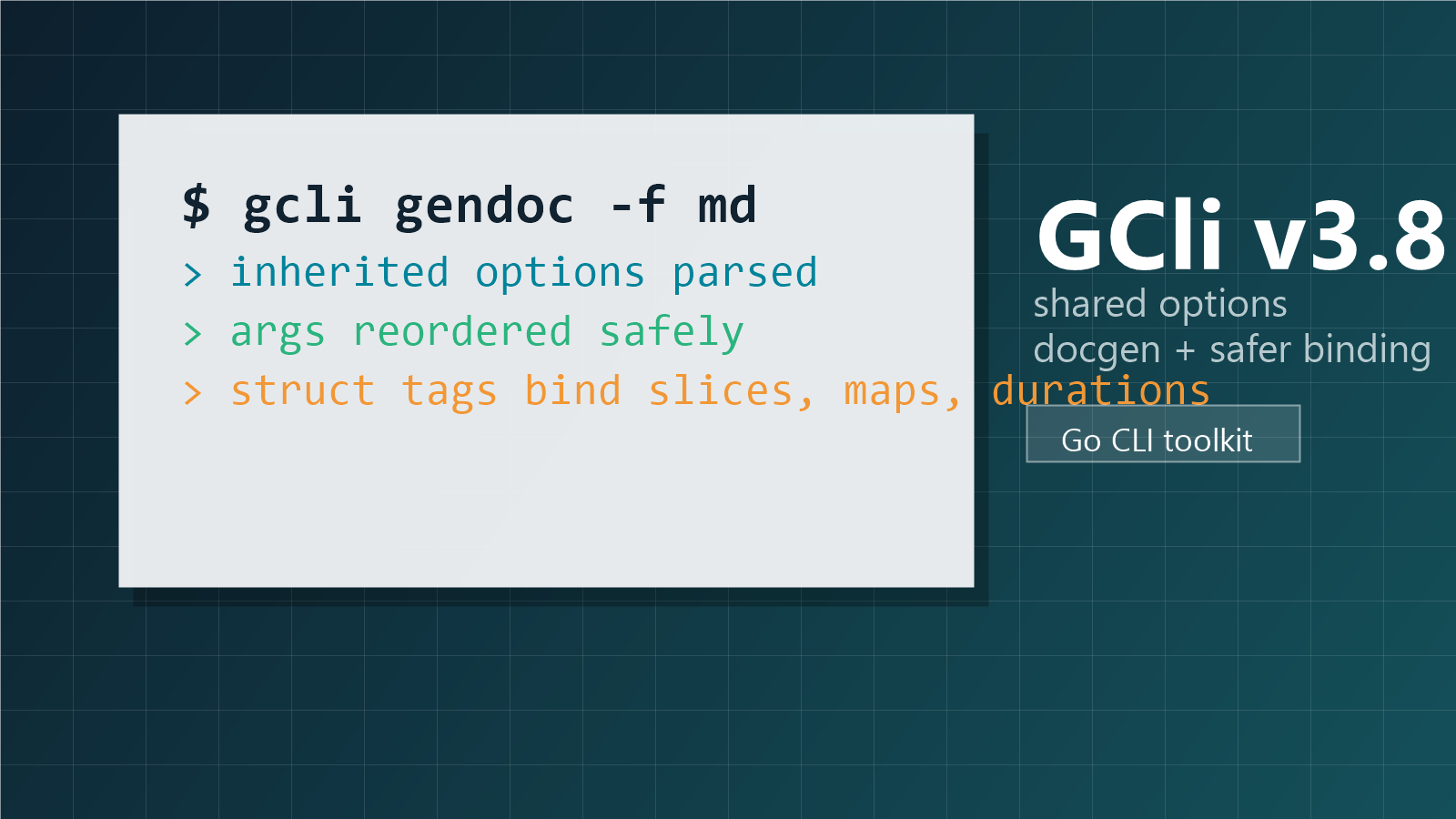
GCli v3.8 is out. Since v3.5, the project has added friendlier argument parsing, richer struct binding, type-safe generic flag helpers, inherited command options, and built-in markdown/man-page generation.
If you maintain a nested CLI rather than a small command wrapper, this release is worth a closer look.
- Project: https://github.com/gookit/gcli
- API docs: https://pkg.go.dev/github.com/gookit/gcli/v3
- Full diff: v3.5.0…v3.8.0
What changed
The v3.6 to v3.8 cycle focused on these areas:
- Args can be reordered before parsing, so
myapp build src/ --name tomstill sees--name. - Struct binding now supports
[]string,[]int,[]bool,time.Duration,map[string]string, andenumtags. - Struct binding no longer uses
unsafe. gflag.Opt[T]andgflag.BindVar[T]provide a generic flag binding API.Command.SharedOpts()adds inherited options for command trees.docgenand the builtingendoccommand can generate markdown and man pages.
There is also a package rename: events is now gevent, with gcli.Evt* aliases available from the root package.
Args after positional values now work
GCli used to behave like the standard library flag package: once parsing reached the first non-flag token, option parsing stopped. That meant this could miss --name tom:
myapp build src/ --name tomSince v3.6, GCli can reorder args before parsing. These two commands now behave the same:
myapp build --name tom src/
myapp build src/ --name tom
The feature is enabled by default. It keeps value-taking options with their values, does not let bool options consume unrelated args, and preserves the meaning of --opt=val, negative numbers, a lone -, and everything after --.
Nested commands are handled conservatively: only the final command’s args are reordered. Parent and child option sets are not mixed.
If your program needs strict standard-library ordering, disable it:
c.ParserCfg().DisableReorderArgs = true

// or via the config function
gflag.WithReorderArgs(false)
See _examples/cmd/reorder_demo.go for a runnable example.
Struct binding supports more Go types
Struct binding is one of GCli’s more useful features. Before v3.7, binding lists, maps, or durations often meant using helper types such as gflag.Strings or KVString. Now common Go types work directly:
type deployOpts struct {
    Names []string          `flag:"name=names;shorts=n;desc=name list"`
    Ports []int             `flag:"name=ports;shorts=p;desc=port list"`
    TTL   time.Duration     `flag:"name=ttl;desc=time to live, eg: 1h30m"`
    Meta  map[string]string `flag:"name=meta;shorts=m;desc=key=value metadata"`
    Lang  string            `flag:"name=lang;shorts=l;desc=language;enum=go,php,java"`
}

c.MustFromStruct(&deployOpts{})
The command can then be called like this:
myapp deploy -n a -n b -p 80 -p 443 --ttl 1h30m -m k1=v1 -m k2=v2 -l goThe new binding behavior:
[]string,[]int, and[]boolbecome repeatable options.time.Durationparses native Go duration strings such as1h30m.map[string]stringaccepts repeatedkey=valuepairs.enum:"go,php,java"provides completion candidates and rejects values outside the set.
Internally, the binder no longer uses unsafe; it now gets field pointers through reflect.Value.Addr().Interface().
Anonymous embedded structs now expand under all three tag rules: named, simple, and field. v3.8 also fixes embedded unexported types that were previously skipped.
Generic flag helpers reduce API noise
The older per-type APIs still work: BoolVar, IntVar, StrVar, Float64Var, and the rest are unchanged.
v3.7 adds a generic entry point that dispatches from the pointer type:
var (
    name string
    age  int
    tags []string
    ttl  time.Duration
)

gflag.Opt(&c.Flags, &name, "name", "n", "tom", "the user name")
gflag.Opt(&c.Flags, &age,  "age",  "a", 18,    "the user age")
gflag.Opt(&c.Flags, &tags, "tag",  "t", nil,   "the tags, repeatable")
gflag.Opt(&c.Flags, &ttl,  "ttl",  "",  time.Duration(0), "time to live")
For full option metadata control, use gflag.BindVar[T]:
var langs []string
gflag.BindVar(&c.Flags, &langs, gflag.NewOpt("langs", "language list", nil))
This is not a forced replacement for existing APIs. It is a cleaner default for new code.
SharedOpts adds the missing middle layer
The biggest v3.8 addition is Command.SharedOpts().
GCli already had app-level global options and command-level local options. What was missing was the middle layer: options defined by a parent command and inherited by its children. SharedOpts() fills that role, close to cobra’s PersistentFlags.
var gitDir string

top := &gcli.Command{Name: "git", Desc: "git-like demo"}
top.SharedOpts().StrOpt(&gitDir, "git-dir", "", ".git", "the git data dir")

top.Add(&gcli.Command{
    Name: "status",
    Func: func(c *gcli.Command, _ []string) error {
        gcli.Printf("git dir: %s\n", gitDir)
        return nil
    },
})
All of these assign /x to gitDir:
myapp git --git-dir /x status
myapp git status --git-dir /x
myapp git status arg --git-dir /x
The rules are straightforward:
- A local option on a child command wins over an inherited option with the same name.
- A required shared option is validated at the final leaf command.
- Options inherited from ancestors appear under
Inherited Optionsin sub-command help.
Under the hood, Parser.InheritOptsFrom(src, category...) re-registers inherited options by their underlying flag.Value, so parent and child commands write the same bound variable.
docgen exports markdown and man pages
v3.8 adds a docgen package for generating markdown and man pages from commands:
import "github.com/gookit/gcli/v3/docgen"

docgen.MarkdownTree(app, "./docs")
docgen.ManTree(app, "./man")

md  := docgen.CmdMarkdown(cmd)
man := docgen.CmdMan(cmd)
You can also expose generation from your CLI:
import "github.com/gookit/gcli/v3/builtin"

app.Add(builtin.GenDoc())
Then run:
./cliapp gendoc -f md  -o ./docs
./cliapp gendoc -f man -o ./man
The generator handles several practical details: it strips color tags from examples, expands variables such as {$fullCmd}, preserves multi-line examples, includes the app version in the overview, and uses gflag.CliOpt.TypeName() to show option types.
Migration notes
Two changes may require code updates.
The event package was renamed:
| Before | After |
|---|---|
import "github.com/gookit/gcli/v3/events" | import "github.com/gookit/gcli/v3/gevent" |
events.OnCmdRunBefore | gevent.OnCmdRunBefore or gcli.EvtCmdRunBefore |
Per-app parse state moved:
| Before | After |
|---|---|
GlobalOpts.ShowHelp / ShowVersion / inCompletion / genCompletion | per-app AppOptions, accessed with app.AppOpts() |
App.Opts() still returns the process-level *GlobalOpts, so app.Opts().Verbose and app.Opts() == gcli.GOpts() are unchanged. Only the fields that describe one app’s runtime parse state moved, which prevents multiple App instances in one process from sharing that state.
Arg reordering is also a behavior change, but a more permissive one. If you depended on the old behavior, set Config.DisableReorderArgs = true.
Upgrade
go get -u github.com/gookit/gcli/v3@latestAfter upgrading, the examples worth checking first are reorder-args, struct-types, and struct-flag. They cover the changes most likely to affect real command code.
Issues and suggestions can go to GitHub Issues.